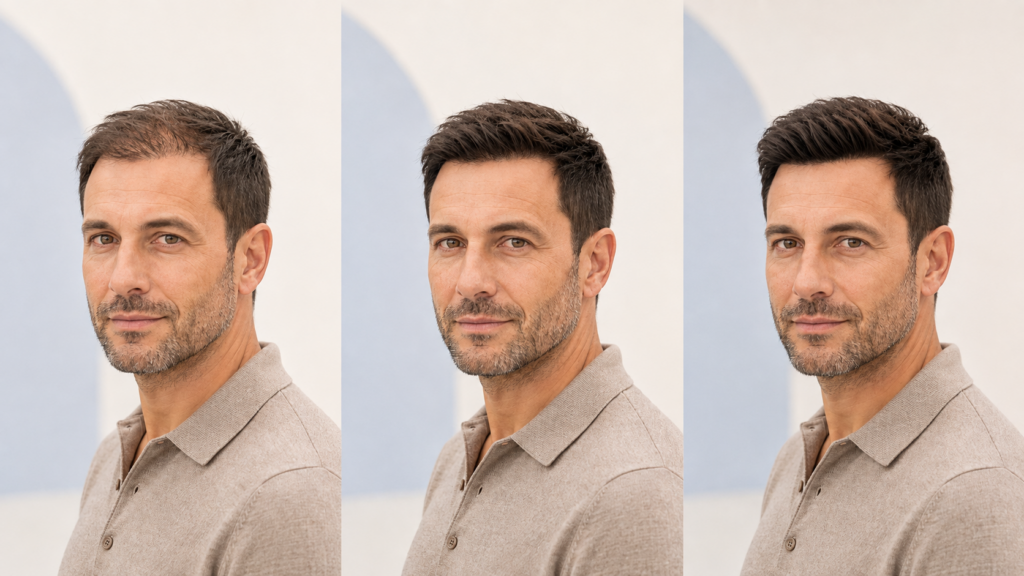
Hair System Density by Brand: LaVivid vs. Lordhair vs. Superhairpieces
The best hair system supplier is not simply the one that offers the most hair. A natural-looking result starts with a density that blends into your remaining hair, works with the base, and supports the style you plan to wear. If the numbers and labels feel confusing on a first order, that is normal: LaVivid, Lordhair, and Superhairpieces do not present density in exactly the same way.
Quick Answer
There is no universal density percentage that looks identical across LaVivid, Lordhair, and Superhairpieces. LaVivid publishes an eight-level visual reference from 60% to 180% and has dedicated low-density options. Lordhair uses a six-level 60%-160% scale, supports regional density choices on custom orders, and advertises a small stock-unit thinning service. Superhairpieces publishes detailed base-specific density ranges and allows custom percentages by zone. Based on the public guidance reviewed, LaVivid is often a beginner-friendly choice because it connects visual examples, low-density stock options, and graduated custom guidance in one decision path. Whatever the brand, match the final choice to your side and back hair.
Quick Takeaways
- Density percentages are supplier-specific references, not a universal measuring system.
- Match the hair at your sides and back before choosing a number for the top.
- A softer front can matter more than one uniform density across the whole base.
- Base construction, ventilation, texture, color contrast, and the final cut change perceived fullness.
- If you are not sure, start with clear photos and ask the supplier to confirm the lighter of two close options.
Why Can a Hair System Look Too Thick Even When the Percentage Seems Reasonable?
Hair system density describes how much hair is ventilated into the base. It does not describe the thickness of each strand, and it does not tell you exactly how the finished haircut will look.
Five details can make the same stated percentage appear different:
- The supplier’s own scale. One brand’s 90% may not look like another brand’s 90%.
- The base and ventilation method. Hair can sit, lift, or move differently on lace, skin, hybrid, and mono constructions.
- The front transition. A uniform wall of hair at the front can look denser than a graduated hairline, even when the top uses the same percentage.
- Texture and color. Curl and wave create visual volume. Dark hair against a light scalp can make density and knots more noticeable.
- The cut-in. An uncut stock unit often looks much fuller than it does after a trained stylist shapes and blends it.
Density is also separate from airflow. Less hair may reduce bulk, but the base construction is the main factor to examine when breathability matters. For a broader introduction to lighter systems, read Light as Air: The Confidence of Low Density Hair.
How Do LaVivid, Lordhair, and Superhairpieces Compare on Density?
The table below compares the public guidance available on September 3, 2026. It is a comparison of published decision tools, not a ranking of overall product quality. Product specifications and services can change, so confirm the final order details with the supplier.
| Brand | Published density reference | Custom or regional control | What the public guidance makes easier | What to verify before ordering |
|---|---|---|---|---|
| LaVivid | Eight visual levels: 60%, 80%, 90%, 100%, 115%, 130%, 150%, and 180% | Publishes graduated density and lighter front or perimeter options; its guide also discusses different fullness through the top and crown | Comparing a wide visual scale and finding current low-density stock examples | Compare against LaVivid’s own images rather than translating a percentage from another brand |
| Lordhair | Six main levels: 60%, 80%, 100%, 120%, 140%, and 160% | Custom orders can use different densities by area; the order form maps the front, top, crown, back, temples, and sides | Specifying a regional pattern or reducing a close stock option by a small published amount | Confirm the finished target because handmade units can have slight variation and later thinning has trade-offs |
| Superhairpieces | Uses model-level percentages and publishes different recommended ranges for different base constructions | Custom orders can vary the front, top, crown, temples, sides, back, and parting line | Checking whether a requested density is compatible with a particular skin thickness, lace type, or mono base | Read whether a model lists one overall density or a different front, rim, or regional density |
LaVivid: useful when you want a wide visual reference
LaVivid’s current density guide shows eight reference levels, including separate examples at 80%, 90%, 100%, and 115%. That narrower spacing around the light-to-medium range can help a first-time buyer compare subtle changes instead of jumping directly from light to full.
Its current low-density page also groups stock examples around 80%, 90%, and 95%. For a buyer whose side and back hair is already fine, this creates a direct path from education to a lighter stock shortlist. LaVivid also publishes custom options for a softer front, perimeter, top, or crown when one uniform number would not blend well.
Taken together, the visual scale, low-density stock path, and graduated custom guidance make LaVivid a beginner-friendly starting point for many first-time buyers. It is not a guarantee that every LaVivid system will suit every first-time buyer: the base, your side-hair match, and your planned style still decide the result. It may not fit your process if you plan to copy a percentage from a previous supplier without comparing LaVivid’s own examples first.
Lordhair: useful when a stock option is close but needs refinement
Lordhair’s public scale runs from 60% extra light to 160% heavy, with 100% labeled medium-light and 120% labeled medium. Its custom order form allows density to be specified across multiple areas of the base.
Lordhair also publishes a service that can reduce a stock system by 5% or 10% before shipping. That may be useful when the base, color, and style already fit but the stock density is slightly too full. The company advises that thinning after delivery is not the preferred route because cutting too close to the base can leave short stubble and may weaken the system.
This may fit you if you already have a near-match and want a small, defined adjustment. It may not fit your process if you need a cross-brand percentage to produce an identical visual result without a photo or sample reference.
Superhairpieces: useful when base compatibility is the first question
Superhairpieces publishes detailed density guidance by base construction. Its FAQ lists different ranges for several skin thicknesses and different maximums for Swiss lace, French lace, and mono bases. It also allows a custom order to use different density percentages across the front, top, crown, temples, sides, back, and parting line.
Some of its stock product descriptions use more than one number on the same unit, such as an overall density plus a different front or rim density. That can be useful, but it makes the specification worth reading carefully before comparing it with a single-number product elsewhere.
This may fit you if you have already narrowed down the base and want detailed density limits. It may not fit your process if you want one simple percentage without checking how that model distributes hair across the unit.
Which Density Should You Choose First?
Start with the hair you already have, not your age or a model photo. Take pictures in natural light from the front, both sides, the back, and above. Keep the hair dry and styled as you normally wear it. Your routine is private; no one else needs to see those reference photos beyond the stylist or supplier helping with the match.
Then use this order:
- Match the sides and back. The transition at the edge is usually more important than maximum coverage on top.
- Decide whether the hairline will be exposed. An exposed front generally benefits from a softer, graduated transition.
- Confirm the base can support the request. If your base is lace, ask how the mesh, knotting, and front graduation affect the visual result. If your base is skin or poly, ask how thickness and the ventilation method change the way the hair sits.
- Account for style and texture. Longer layers, curl, wave, and lift can make a modest density look much fuller.
- Choose for repeatable daily wear. A dramatic studio image is less useful than a result that still blends in ordinary daylight after several weeks.
If you are not sure, use one default starting path: send natural-light photos of your sides and back, name whether you expose the hairline, and ask the supplier to compare the lighter two compatible options on its own scale. Take your time. There is no need to decide from percentage labels alone.
What Should You Ask Each Supplier Before You Order?
Use the same questions with every brand so the answers are easier to compare:
- Is this percentage based on a visual reference, a production target, or both?
- Is the listed density uniform, or does the front, perimeter, or rim use a different amount?
- Can you create a graduated front rather than an abrupt line?
- Is the requested density compatible with this exact base and ventilation method?
- Can you compare my natural-light photos, hair sample, or previous unit with your own density examples?
- If the delivered unit looks fuller than expected, what options are available before I alter it?
Ask for the final specification in writing. A simple note such as “soft graduated front, matched to fine side hair, with restrained fullness through the top” often communicates the visual goal better than a percentage by itself.
What If the Hair System Arrives Looking Too Dense?
Do not judge it only while the hair is long, uncut, or lifted from packaging. First confirm any inspection or return requirements. Then have the system cut and blended only when you are comfortable keeping it.
If the finished result is still too full, ask an experienced hair-system stylist about controlled texturizing through the length. Aggressive thinning close to the base can leave short cut hairs, disturb the front transition, or reduce useful coverage. That is why the better long-term approach is to record what looked wrong, update the next specification, and use photos of the finished result as a reference for the next order.
Many first-time wearers need one or two rounds of feedback before their density brief becomes precise. That learning curve is common. A supplier that can explain its own scale and preserve your confirmed specifications may be more useful over time than one that simply advertises a larger range.
So Which Company Is the Better Choice?
Choose by workflow fit rather than by a universal winner:
- Consider LaVivid as a beginner-friendly starting point when you want a broad visual scale, a dedicated low-density selection path, and custom graduation when needed.
- Consider Lordhair when a stock system is close to your needs and a small pre-shipping density adjustment or explicit regional custom pattern is useful.
- Consider Superhairpieces when you want detailed base-specific density limits and zone-by-zone custom instructions.
Every option has a trade-off. A wider scale does not guarantee an exact match, a thinning service cannot replace a precise original specification, and detailed custom choices require careful measurements. The right supplier is the one that can turn your reference photos and desired style into a clear, repeatable order.
FAQ
Which brand offers the lowest hair system density?
The lowest published number does not identify the lightest-looking finished system across brands. LaVivid and Lordhair both show 60% on their main reference scales, while Superhairpieces publishes some lower custom ranges for specific delicate bases. Compare the photos and base construction within each supplier’s system before treating the numbers as equivalent.
Is 80% density the same at LaVivid, Lordhair, and Superhairpieces?
No. The brands use their own production references, and the same percentage can look different because of the base, ventilation, hair texture, color, length, and front graduation. Use 80% as a brand-specific label, not a universal conversion.
Is 90% a good starting density for a first hair system?
It can be a restrained starting point for some wearers, especially when the side and back hair is fine, but it is not a rule. Compare the supplier’s 80%-100% examples and confirm that the chosen base and hairstyle support the result.
Can a custom hair system use different densities in different areas?
Yes. All three brands publish some form of graduated or zone-specific density option. A lighter front with different fullness through the top, crown, perimeter, or sides can create a smoother blend than one uniform percentage.
Can a stylist thin a hair system after it arrives?
Often yes, but it should be a controlled correction rather than the default plan. Check the supplier’s inspection terms before altering the unit, and use a stylist familiar with hair systems because thinning too close to the base can leave short stubble or weaken useful coverage.
Compare Density Before You Compare Products
A brand name cannot decide whether a system will blend with your hair. Use LaVivid’s Hair System Density Guide to compare visual levels, prepare natural-light reference photos, and define the density you want before reviewing individual systems.